Full-Funnel Attribution: Using Amazon Marketing Cloud to Connect DSP, Sponsored Ads & Off-Amazon Channels
See how Amazon Marketing Cloud connects DSP, Sponsored Ads, and off-Amazon channels so you can measure true incrementality and grow profitably.
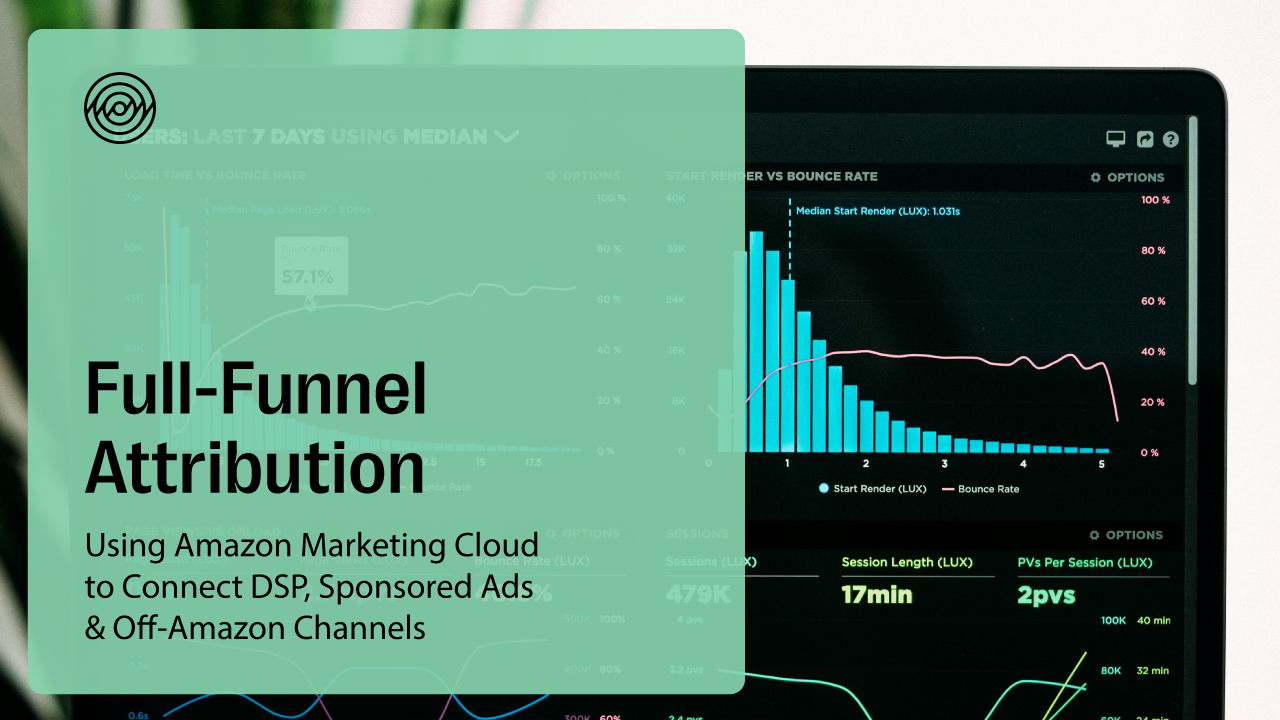
Amazon Marketing Cloud (AMC) is the fastest way to see how your Amazon demand-side platform (DSP) ads, Sponsored Ads, and off-Amazon channels work together to drive sales. Without it, you are judging each channel in isolation, usually by last click, and underfunding the upper-funnel media that fills your pipeline. With it, you can see the full path to purchase, measure true incrementality, and shift budget toward the touchpoints that grow your business profitably.
This guide shows you how to build a full-funnel attribution framework in AMC: what it is, how to connect your channels, which questions to ask first, and where brands go wrong.
Key Takeaways
- AMC is a clean room built for Amazon Ads data. It lets you query pseudonymized, event-level signals from your Amazon DSP and Sponsored Ads campaigns, and combine them with your own first-party data, without exposing individual shoppers.
- Last-click attribution undervalues the funnel. Shoppers often see display, video, and streaming TV ads before they ever search, click a Sponsored Products ad, and buy. Console reports rarely show that sequence. AMC does.
- Off-Amazon channels connect through three layers. DSP reach beyond Amazon properties shows up natively in AMC, Amazon Attribution covers clicks from search, social, email, and affiliate traffic, and hashed first-party data uploads cover the rest.
- Incrementality matters more than attribution alone. Use AMC for audience-split and geo-split testing, then validate against New-to-Brand (NTB) rates, Total Advertising Cost of Sale (TACoS), and organic lift.
- AMC is more accessible than ever. It is available at no cost to eligible advertisers, and Amazon has expanded eligibility to advertisers running Sponsored Ads, directly or through partners.
Why Last-Click Attribution Fails Your Full Funnel
Last-click attribution gives 100% of the credit to the final ad a shopper touched before buying. On Amazon, that final touch is usually a branded Sponsored Products ad, which means your lowest-funnel campaigns look like heroes and your awareness campaigns look like waste.
That is a measurement problem, not a performance problem. Consider a typical shopper journey:
- A shopper sees your streaming TV ad on a Fire TV device.
- Two days later, your display ad appears on a publisher site while they browse.
- The following week, they search a category keyword on Amazon and view your detail page from a Sponsored Brands ad.
- They leave, then return through a branded Sponsored Products ad and buy.
In a standard console report, step 4 gets all the credit. Steps 1 through 3 did the work of building awareness and consideration, and they get none of the recognition. When you cut budget based on that view, you cut the exact campaigns that fed your branded search volume. Your ROAS looks healthy for a few weeks, then your NTB customers dry up.
Full-funnel attribution fixes this by tying every exposure to the same shopper path, so you can see which combinations of ads lead to purchases and which ones only claim credit at the finish line.
What Amazon Marketing Cloud Is & Why It Matters
AMC is Amazon's secure, privacy-safe, cloud-based clean room. Amazon describes it as a place where advertisers can perform analytics and build audiences across pseudonymized signals, including Amazon Ads signals and their own inputs. In practical terms, you write SQL queries against event-level data about the ads Amazon served you and the shopping, browsing, and streaming activity connected to them. You receive aggregated, anonymous results. You never see individual shopper records.
A few facts that shape how you use it:
- Each advertiser works in a dedicated instance. Your instance is linked to your specific Amazon DSP and Sponsored Ads accounts.
- Signals go deep. Advertisers can access hundreds of fields about their Amazon Ads campaigns, including ad-attributed impressions, clicks, and conversions. Amazon has also extended the lookback window, so you can analyze longer-term trends and purchase cycles. (Check the AMC product page for the current window, since it has changed over time.)
- It costs nothing to access for eligible advertisers. Your costs come from the expertise and time needed to write queries and act on results.
- Your data stays protected. AMC only accepts hashed or pseudonymized inputs, as the AWS Industries blog notes in its walkthrough of customer data platform (CDP) integration.
AMC was originally limited to advertisers using Amazon DSP. In October 2024, Amazon expanded eligibility so registered partners could use it for clients running only Sponsored Ads. In 2025, Amazon went further and made AMC available to all Sponsored Ads advertisers, including those using Sponsored Products, Sponsored Display, Sponsored Brands, and Sponsored TV. If you run Amazon PPC and have never opened AMC, you are leaving your richest dataset untouched.
One caution: AMC is not a holistic, all-channel measurement product. It is built around Amazon Ads signals, and industry analysts have pointed out that it works best as part of your wider measurement stack rather than a replacement for it. That is why the framework below combines AMC with Amazon Attribution and your own data.
Connect DSP & Sponsored Ads Into One Path to Purchase
Your DSP and Sponsored Ads campaigns generate separate reports in the Amazon Ads console. AMC is where you join them.
Because both campaign types feed the same instance, you can query shopper journeys that span them. Start with these analyses:
Path-to-conversion analysis. See the most common sequences of ad exposures that precede a purchase. You may find that shoppers exposed to DSP display and a Sponsored Brands ad convert at a meaningfully higher rate than shoppers who only saw one, which gives you a data-backed reason to run both.
Overlap & reach analysis. Find out how many shoppers saw only DSP, only Sponsored Ads, or both. Large non-overlapping groups signal an opportunity to extend reach. Heavy overlap with low incremental conversion signals wasted frequency.
Frequency & timing analysis. Learn how many impressions it takes before conversion rates flatten, and how many days typically pass between first exposure and purchase. Use those answers to set frequency caps and lookback windows that match real shopper behavior instead of defaults.
NTB analysis across channels. Compare NTB rates for shoppers who entered through DSP versus Sponsored Ads. This tells you which channel is truly acquiring new customers and which is harvesting existing demand.
Upper-funnel assist analysis. Measure how DSP prospecting impressions influence detail page views (DPVs), branded search volume, and Sponsored Products conversion rates in the days that follow.
When AO2 builds a DSP program, AMC reporting is part of the foundation. It lets you see multi-touch impact across Sponsored Ads and DSP rather than guessing at it, and it keeps your DSP investment accountable to profit, not just impressions.
Bring Off-Amazon Channels Into the Picture
The title of this guide promises off-Amazon channels, so here is the honest version of how that works. No single tool tracks every channel natively. Instead, you stack three layers.
Layer 1: DSP Reach Beyond Amazon Properties
Amazon DSP delivers ads across Amazon properties, publisher sites, apps, and streaming TV. Because these impressions are Amazon Ads events, they appear in your AMC instance. You can analyze how off-Amazon DSP exposures affect on-Amazon behavior, such as DPVs, add-to-carts, and purchases. This is your first and easiest window into the off-Amazon funnel.
Layer 2: Amazon Attribution for Search, Social, Email & Affiliate
Amazon Attribution is a free measurement solution that shows the on-Amazon impact of non-Amazon marketing across channels including search, social, display, video, email, and affiliate or influencer campaigns. You generate tags for each strategy, then add them to your ads and links. Amazon reports that advertisers who optimized their non-Amazon media with Attribution insights saw an average 18% increase in NTB sales.
Use Attribution to answer one question: which of your external campaigns send shoppers who actually buy on Amazon? Engagement metrics like clicks and CTR (click-through rate) only tell you who showed up. Attribution tells you who purchased.
Layer 3: First-Party Data Inside AMC
You can upload hashed first-party data into AMC, such as customer lists, email engagement, or site activity, and join it with your Amazon Ads signals. The AWS blog on CDP integration describes use cases like measuring the impact of Amazon Ads campaigns on direct-to-consumer engagement and conversions, and checking whether Amazon Ads reached incremental potential customers beyond your existing audience.
This layer is where brands with a Shopify store, a brick-and-mortar footprint, or a retail media presence on other marketplaces gain a real edge. If you sell on Walmart too, a unified plan across retail media networks helps. AO2 manages Walmart advertising alongside Amazon so your measurement does not stop at the Amazon border.
What this stack does not do: it will not give you a perfect, user-level view of every touchpoint on Meta, Google, or TikTok. For those channels, pair this framework with media mix modeling (MMM) or multi-touch attribution (MTA) so you are not asking one tool to answer every question. AO2's enterprise approach includes MMM and MTA alignment for exactly this reason.
Build Your Full-Funnel Attribution Framework in 5 Steps
Follow this sequence to move from scattered reports to a single source of truth.
Step 1: Define Your Funnel & Your KPIs
Assign each campaign type to a funnel stage and a primary metric. A simple model:
- Funnel Stage: Awareness
- Typical Tactics: DSP prospecting, streaming TV, Sponsored Brands video
- Primary KPIs: Reach, frequency, DPVs
- Funnel Stage: Consideration
- Typical Tactics: DSP remarketing, Sponsored Display, Sponsored Brands
- Primary KPIs: DPV rate, add-to-carts, NTB DPVs
- Funnel Stage: Conversion
- Typical Tactics: Sponsored Products, DSP remarketing
- Primary KPIs: ROAS, ACoS, conversion rate
- Funnel Stage: Loyalty
- Typical Tactics: Replenishment audiences, email
- Primary KPIs: Repeat purchase rate, LTV
Judge each stage by its own job. A prospecting campaign with a lower ROAS can be your best investment if it drives high NTB rates and lifts branded search.
Step 2: Set Up & Verify Your AMC Instance
Make sure your AMC instance is linked to every relevant DSP and Sponsored Ads account. Confirm which signals are available, set up recurring queries, and document your naming conventions. Brands that start early collect more history to analyze later, so do not wait for a perfect plan.
Step 3: Tag Your Off-Amazon Channels
Create Amazon Attribution tags for every external campaign driving traffic to Amazon, and use consistent naming by channel, campaign, and creative. Messy tagging is the most common reason attribution data becomes unusable six months later.
Step 4: Run Your Baseline Queries
Before changing anything, capture your starting point:
- Path-to-conversion sequences for your top ASINs (Amazon Standard Identification Numbers)
- Overlap between DSP and Sponsored Ads audiences
- NTB percentage by channel
- Time-to-conversion and optimal frequency
These baselines make your later results provable.
Step 5: Reallocate, Test & Repeat
Use what you find to shift budget, adjust frequency caps, and build new audiences. Then run structured tests to confirm the changes worked. Which brings us to incrementality.
Measure Incrementality, Not Just Attribution
Attribution tells you which ads were present before a sale. Incrementality tells you which ads caused additional sales that would not have happened otherwise. You need both.
AMC supports incrementality work in several ways:
- Audience-split testing. Hold out a portion of an audience from a campaign, then compare conversion and NTB rates against the exposed group.
- Geo-split testing. Vary spend by region and compare results to isolate the impact of a channel.
- Halo measurement. Measure how DSP spend influences organic and branded search performance, not just directly attributed sales.
- Cannibalization checks. Confirm that your retargeting is reaching shoppers who needed the nudge rather than shoppers who were about to buy anyway.
Pair these tests with a view of your total business. If DSP spend rises and TACoS falls over time because organic sales grow, you are building real, compounding demand. If attributed sales rise but total sales stay flat, you are paying for conversions you would have earned anyway.
Turn AMC Insights Into Audiences & Action
Measurement only matters when it changes what you do. AMC lets you build custom audiences from your analysis and activate them in Amazon DSP and Sponsored Ads. Some high-value examples:
- High-intent non-purchasers. Shoppers who clicked a Sponsored Products ad or viewed a detail page multiple times but did not buy.
- High-margin ASIN viewers. Shoppers who engaged with your most profitable products, so you can push your best-margin items to the people most likely to buy them.
- Replenishment cohorts. Shoppers approaching the typical repurchase window for consumable products, which you identify from your own replenishment curves.
- Lapsed customers. Past buyers who have not purchased in a set period, for win-back campaigns.
- Cross-sell audiences. Shoppers who bought one product and are likely to want a complementary one.
Amazon has also added shopping analytics inside AMC, including product purchase frequency, purchase sequence, and frequently bought together products. You can use those insights to calibrate your marketing cadence, promotion strategy, and bundling decisions.
The loop looks like this: measure, build the audience, activate it, measure again. Each cycle sharpens your targeting and lowers your blended customer acquisition cost (CAC).
Avoid These Common AMC Attribution Mistakes
Treating AMC as a reporting tool only. The biggest value comes from audiences and tests, not dashboards. If you only run template queries, you are using a fraction of what it can do.
Ignoring the data's limits. AMC is aggregated and privacy-protected, so small audiences may return thin or suppressed results. Design your queries and test groups with enough volume to produce meaningful answers.
Comparing numbers across tools without reconciling definitions. AMC, the Amazon Ads console, and Amazon Attribution use different attribution windows and methodologies. Document the definitions you use and compare like with like.
Judging DSP too early. Initial engagement can move within weeks, but meaningful sales and ROI usually take two to three months of optimization and data collection. Cutting a program in week four means cutting it before the data can speak.
Skipping the SQL skills. AMC rewards teams that can write and manage queries at scale, especially across several brands or marketplaces. If you do not have that expertise in house, work with an agency that does.
Letting measurement drift from strategy. Every query should trace back to a business decision: where to spend, what to cut, who to target. If an analysis cannot change a decision, skip it.
See What Full-Funnel Measurement Looks Like in Practice
Results matter more than theory, so here is what a full-funnel DSP program with AMC-backed measurement can deliver.
Superieur Electrolytes partnered with AO2 in 2025 to scale reach and customer acquisition through Amazon DSP in a crowded nutrition category. AO2 built a full-funnel program covering awareness, consideration, conversion, and efficiency. In just 3.5 months, the brand delivered:
- 4.45M DSP impressions
- 2,016 add-to-carts
- 1,956 New-to-Brand detail page views, representing 17% of all DPVs
The goal was never just impressions. It was incremental growth, not cannibalization, with spend managed to hold healthy cost-per-click (CPC) levels.
Across AO2's DSP work, brands have seen a 17% increase in NTB customers and triple-digit month-over-month sales increases in the first 90 days. On the Sponsored Ads side, AO2 helped Hell's Kitchen scale to $5M in annual sales in 18 months with optimized ads and a stronger storefront. You can browse more AO2 case studies to see how the approach adapts across categories.
Match Your AMC Approach to Your Growth Stage
You do not need an enterprise budget to benefit, but your approach should fit your scale. AO2 organizes its DSP and AMC work in three stages:
- Launch (about $250K to $500K per month on Amazon). Prospecting and retargeting starter campaigns, a baseline AMC readout using template queries, and a KPI focus on reach, DPVs, NTB orders, and payback.
- Scale (about $500K to $1M per month). Full-funnel campaigns including connected TV (CTV), audience stacking, creative testing, custom AMC queries, and incrementality testing, with a focus on ROAS, TACoS impact, NTB percentage, and replenishment curves.
- Enterprise ($1M+ per month, complex catalogs, hybrid 1P/3P, or international). Multi-country orchestration, AMC automation and audience sync, business intelligence integration, and MMM and MTA alignment, with a focus on contribution margin, lifetime value, and cross-channel halo.
Smaller DSP budgets can still produce value. With a longer AMC lookback window, established brands can pull insight from years of historical data even when current DSP spend is modest. AO2 has no minimum budget for DSP, though campaigns under $5K may not generate enough data for long-term optimization.
Answer Your Top Full-Funnel Attribution Questions
What Is Amazon Marketing Cloud?
Amazon Marketing Cloud (AMC) is Amazon's privacy-safe, cloud-based clean room. It lets advertisers analyze pseudonymized, event-level Amazon Ads signals alongside their own first-party data to measure performance, understand shopper journeys, and build custom audiences. It is available at no cost to eligible advertisers.
Do You Need Amazon DSP to Use AMC?
No longer. AMC originally required DSP usage, but Amazon expanded eligibility so that advertisers running Sponsored Ads, directly or through registered partners, can use it. That said, combining DSP and Sponsored Ads data in AMC unlocks the most valuable cross-channel analysis.
How Does AMC Track Off-Amazon Channels?
Three ways. DSP impressions served beyond Amazon properties appear natively in AMC. Amazon Attribution measures the on-Amazon impact of search, social, email, display, video, and affiliate campaigns. First-party data uploads let you join your own hashed data with Amazon Ads signals. For channels like Meta and Google, pair this with MMM or MTA for a complete view.
What Is the Difference Between AMC and Amazon Attribution?
Amazon Attribution measures how non-Amazon campaigns drive shopping and sales on Amazon, using tags you add to external ads and links. AMC is a clean room for deep, query-based analysis of your Amazon Ads data, including shopper path analysis, audience building, and incrementality testing. Most full-funnel strategies use both.
How Long Does It Take to See Results From Full-Funnel Attribution?
You can see initial engagement changes within about three weeks of launching a DSP program, while meaningful sales and ROI gains typically take two to three months of optimization and data collection. Your first AMC baseline readout can deliver strategic insight much sooner.
What Is Incrementality in Amazon Advertising?
Incrementality measures the additional sales caused by an ad that would not have occurred without it. In AMC, you can test it through audience-split and geo-split experiments, halo analysis on organic and branded search, and cannibalization checks.
Do You Need SQL Skills to Use AMC?
You need SQL to get the most from AMC, since you write queries against your instance. Template queries cover the basics. Custom analysis, automation, and cross-brand scaling are where experienced analysts pay for themselves.
Grow Faster With Full-Funnel Clarity
Your customers do not shop in channels. They move between streaming TV, publisher sites, social feeds, search, and Amazon, often within the same week. Your measurement should follow them.
AMC gives you the shopper-path view that console reports cannot. Amazon Attribution extends it to the channels beyond Amazon Ads. Your first-party data fills in the rest. Together, they let you fund the touchpoints that build demand, cut the ones that only claim credit, and prove it with numbers.
AO2 is an Amazon-first, omnichannel agency and a verified Amazon Ads partner that runs DSP, AMC, and Sponsored Ads as one system. If you want to see what your full funnel looks like, book a strategy call and ask for a sample AMC report. You can also explore AO2's Amazon DSP & AMC services, review our full service lineup, or subscribe to the AO2 newsletter for more Amazon and retail media strategy.
Latest Updates
Curious what AO2 can do for your brand? Schedule a call today.