Retail Media Beyond Amazon: Building a Unified Strategy Across Walmart Connect, Instacart & Target Roundel
Build one retail media strategy across Walmart Connect, Instacart Ads, and Target Roundel, with budget splits, measurement tips, and common mistakes to avoid.
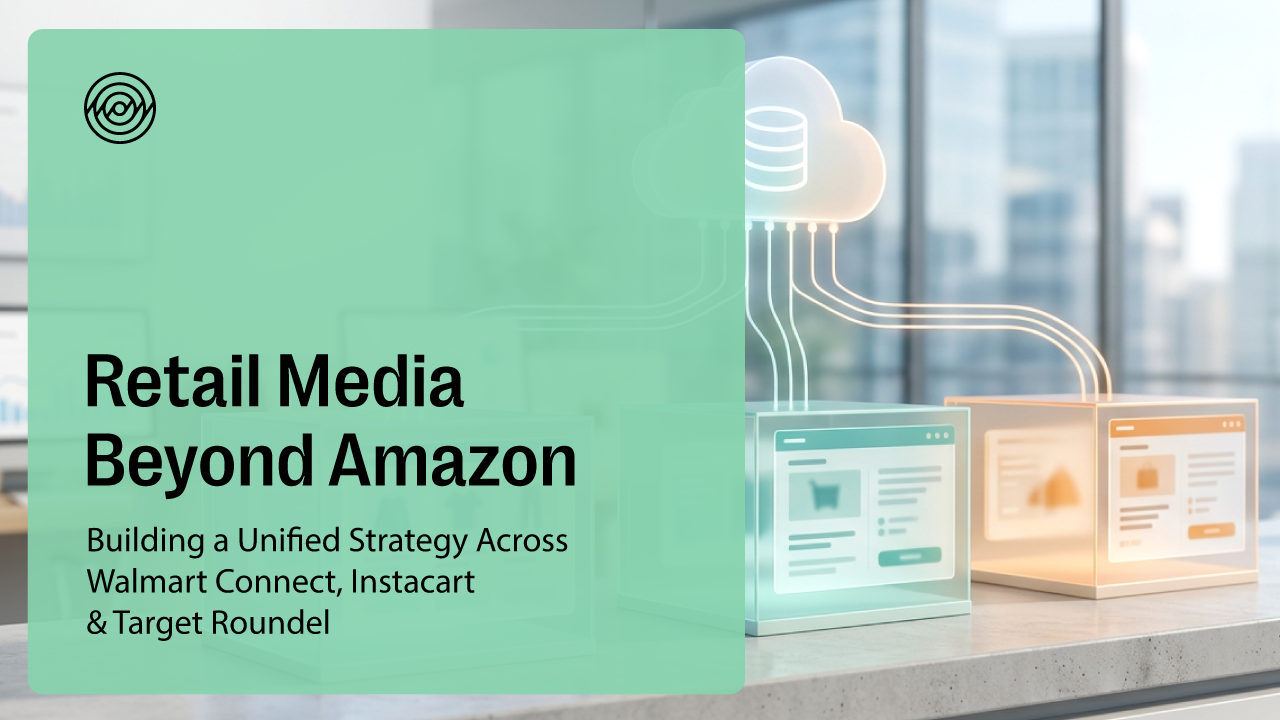
Amazon should anchor your retail media plan, but it should not be the whole plan. Walmart Connect, Instacart Ads, and Target Roundel reach shoppers Amazon does not, and each one rewards a different kind of brand. The winning approach is not to copy your Amazon playbook three times. It is to run one unified strategy with shared goals, shared measurement, and network-specific tactics.
This guide shows you what each network does best, how to split your budget, and how to measure results across all of them without drowning in dashboards.
Key Takeaways
- Retail media is fragmenting fast. Amazon forecasts to capture about 39.8% of U.S. retail media spend in 2025, according to eMarketer data cited by Digital Commerce 360. The remaining majority is up for grabs.
- Walmart Connect is the scale play. Walmart's global advertising revenue grew 46% to nearly $6.4 billion in fiscal 2026, and Walmart Connect in the U.S. rose 41% in Q4, per 8th & Walton's summary of Marketing Dive reporting.
- Instacart is the grocery-intent play. Over 240 retail partners run Carrot Ads, and more than 7,500 brands advertise with Instacart, according to Supermarket Perimeter.
- Target Roundel is the audience-quality play. More than 30% of Roundel's partner media spend now happens off Target's owned properties, which makes it a strong fit for brands that need reach beyond the Target app.
- Unify with one framework. Set one goal hierarchy, one measurement standard, and one creative system, then adapt by network.
Why Your Retail Media Strategy Needs to Look Beyond Amazon
Your shoppers do not live on one marketplace. A household might search Amazon for pantry staples, order groceries through Instacart, pick up household goods at Walmart, and browse home decor at Target, all in the same week. If your media only shows up in one of those moments, you lose the other three.
Retail media also works differently from other advertising channels. Retailers hold first-party purchase data, so you can target shoppers by what they actually buy, and you can tie ad exposure to sales through closed-loop measurement. That is why spend keeps shifting toward retail media, and why every major retailer now sells advertising.
The risk is complexity. Each network has its own ad formats, auction rules, reporting windows, and minimums. Without a unified strategy, you end up with four disconnected programs, four sets of metrics, and no clear view of what is working.
Know What Each Network Does Best
Walmart Connect: Reach Scale & Omnichannel Sales
Walmart Connect gives you access to one of the largest shopper bases in U.S. retail, across Walmart.com, the Walmart app, and more than 4,000 stores. Walmart's advertising business keeps growing, supported by its Vizio acquisition, which added connected TV (CTV) inventory and device-level data to its offering.
Walmart Connect works best when you:
- Sell products shoppers often buy in-store, since Walmart can connect online ads to physical-store sales
- Want value-conscious, family-oriented audiences at scale
- Need CTV and offsite reach tied to retail data
- Sell as a Marketplace seller or supplier, since Walmart's advertising business is drawing growing demand from Marketplace sellers
If you already advertise on Amazon, Walmart is usually the easiest second network. Many of the same skills carry over, including keyword research, listing quality, and conversion optimization. AO2 manages Walmart advertising alongside Amazon, so your campaigns can share insights instead of operating in silos.
Instacart Ads: Capture Grocery Shoppers at the Moment of Purchase
Instacart reaches shoppers who are actively building a grocery basket, which makes it one of the strongest high-intent environments in retail media. Through Carrot Ads, Instacart also powers retail media on grocers' own sites and apps, and its Caper Carts bring ads into physical stores. Instacart has also extended its advertising reach off-platform through partners such as Roku and The Trade Desk, as Retail TouchPoints reports.
Instacart works best when you:
- Sell consumer packaged goods (CPG) in food, beverage, household, or personal care
- Want to reach shoppers across many grocery banners through one buying relationship
- Need to win trial for new products in a category where shoppers compare options quickly
Brands with a heavy grocery mix should treat Instacart as a core channel. Brands with only a small grocery footprint can start with a test budget.
Target Roundel: Reach Quality Audiences With Strong Brand Fit
Roundel is Target's retail media network, and it positions itself closer to a media company than a pure marketplace ad platform. Advertisers can run Target Product Ads through Roundel Media Studio, a self-service platform, or work with Roundel's managed service for broader formats. Target launched Precision Plus to optimize offsite campaigns using its first-party data, and Roundel's footprint spans more than 150 premium publishers, according to P2PI's coverage.
Roundel works best when you:
- Sell in categories where Target over-indexes, such as home, beauty, apparel, and baby
- Care about reaching millennial and Gen Z households with brand-building creative
- Want closed-loop measurement that connects exposure to both online and in-store Target sales
Target's scale is smaller than Amazon's or Walmart's, so Roundel suits brands that value audience fit over sheer volume.
Build Your Unified Strategy in Five Steps
Step 1: Set One Goal Hierarchy
Define what success means before you choose networks. Most brands need a mix of three objectives: grow total sales, acquire new customers, and protect profitability. Rank them, then assign each network a primary role. For example, Amazon drives profitable scale, Walmart expands reach and in-store lift, Instacart wins grocery trial, and Roundel builds brand with a high-value audience.
Step 2: Follow Your Sales Data
Look at where your products already sell. If a third of your revenue comes through Walmart stores and Walmart.com, Walmart Connect deserves a larger share. If grocery drives most of your volume, Instacart moves up. Brands that skip this step often spread budget evenly across networks, which starves the best opportunity.
Step 3: Allocate Budget in Stages
A practical starting point for brands already strong on Amazon is to keep the majority of spend on Amazon and fund new networks as controlled tests.
Step 4: Standardize Your Measurement
Every network reports slightly different metrics with different attribution windows. Create one scorecard with the same core measures across networks:
- Return on ad spend (ROAS) and Advertising Cost of Sale (ACoS), with the attribution window noted
- New-to-brand (NTB) rate, where the network reports it
- Cost per click (CPC) and click-through rate (CTR) by campaign type
- Incremental sales, using holdout tests where possible
- Total business impact, such as lift in organic sales and branded search
Do not compare raw ROAS across networks without adjusting for window length and attribution method. A network with a 14-day window and one with a 30-day window will not produce comparable numbers.
Step 5: Reuse Creative & Content, Then Adapt
Build one core creative system, including your hero images, value propositions, and product video, then adapt it to each network's formats and audience. Product detail pages matter on every retailer, so make sure titles, images, and content are strong before you spend a dollar on ads. Great ads that send shoppers to weak pages waste budget on any network.
Avoid the Most Common Cross-Network Mistakes
- Copying your Amazon structure everywhere. Campaign types, keyword behavior, and shopper intent vary by retailer. Learn each network's rules before you scale.
- Chasing too many networks at once. Start with one new network, prove the economics, and then expand. Depth beats breadth in the first year.
- Ignoring retail fundamentals. Ads amplify what is already there. If your product is out of stock, mispriced, or poorly reviewed, advertising makes the problem more expensive.
- Judging results too soon. New networks need time to gather data and optimize. Plan for at least 60 to 90 days of learning before you make big budget decisions.
- Skipping offsite and CTV. Retail media is expanding beyond onsite search. Target reports that more than 30% of Roundel's partner media spend now happens off its owned platforms, and Walmart and Instacart are both building offsite and CTV capabilities. Your strategy should include a plan for reaching shoppers before they start searching.
Answer Your Top Questions About Retail Media Beyond Amazon
What Is Retail Media?
Retail media is advertising sold by retailers and marketplaces using their own shopper data. Brands buy ad placements on retailer websites, apps, in-store screens, and offsite channels, and they can measure results against actual purchases.
Should You Advertise on Walmart, Instacart, or Target First?
Start where your products already sell best. Walmart Connect is the natural second network for most brands that already advertise on Amazon. Instacart is the stronger choice for grocery and CPG brands. Roundel fits brands in categories where Target over-indexes.
How Much Should You Spend Outside Amazon?
Most brands begin with 15% to 30% of their retail media budget outside Amazon, then adjust based on incremental return. Brands with significant brick-and-mortar sales may move faster.
Can You Measure Retail Media Across Networks?
Yes, with a standardized scorecard and clear notes about attribution windows. For deeper analysis, use incrementality tests and pair retailer data with your own sales and web analytics.
Do You Need an Agency for Multi-Retailer Retail Media?
You can run one network in house, but coordination gets difficult once you add a second or third. An experienced agency helps you share learnings across networks, keep measurement consistent, and avoid duplicated effort.
Grow Across Every Retail Media Network With One Strategy
Amazon will likely remain your largest retail media channel, but your next stage of growth will come from the shoppers you are not reaching yet. Walmart Connect delivers scale and omnichannel lift, Instacart captures grocery intent, and Roundel reaches a distinctive, brand-friendly audience. Treat them as parts of one system, not four separate bets.
AO2 is an Amazon-first, omnichannel agency that manages retail media across Amazon and Walmart. If you want help deciding where to expand next and how to measure it, book a strategy call.
Latest Updates
Curious what AO2 can do for your brand? Schedule a call today.